← Back to the log
Why a global model of reality
Globàlium — Major Model. Lluís M. Xirinacs i Damians.

16 May 2026

Why a global model of reality

We live immersed in fragments. Each discipline sees its own slice, each chart highlights its own indicator, each algorithm optimises its own metric. This specialisation has given us enormous technical power, but at the same time it has left us without a shared language for talking about the whole. And most of the challenges that cut through us today — the climate and energy crises, and entire fields calling to be rethought, like politics, the economy or education — are systemic. They escape the silos. They ask us to look at the whole again.

This is why, at Opengea, we practise something that may seem unusual: thinking the world and building it with code are, for us, two sides of the same gesture. Before writing any code, we ask ourselves with which model of reality we are building. Because every tool — a spreadsheet, an AI model, a digital infrastructure — encodes a worldview. The question is not whether it encodes one, but which one.

A map to think the whole

A global model of reality is, simply, a map broad enough to place any question within it. It does not claim to explain everything; it offers a framework where different disciplines, knowledges and experiences can find their place and converse. It is a way of avoiding two traps at once: the fragment that mistakes itself for the whole, and the abstract whole that can no longer say anything concrete.

This map is a practical tool: it helps us see which dimensions of a topic we have considered and which we have left in the blind spot. And often the blind spot is, precisely, where the problem lies.

Why the Globàlium

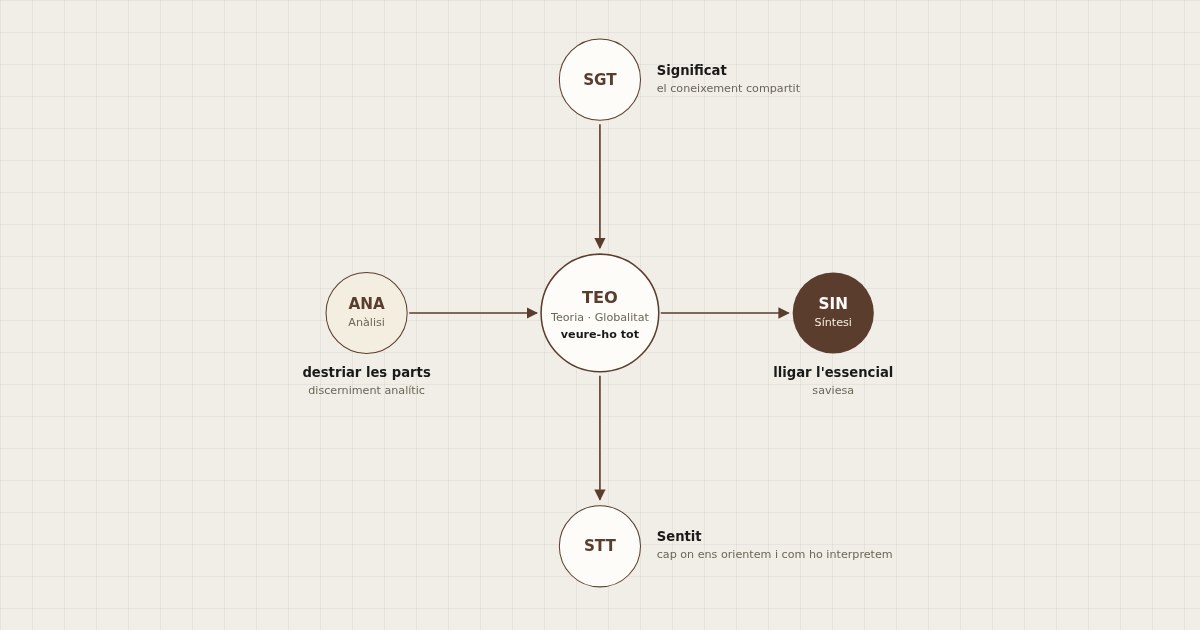
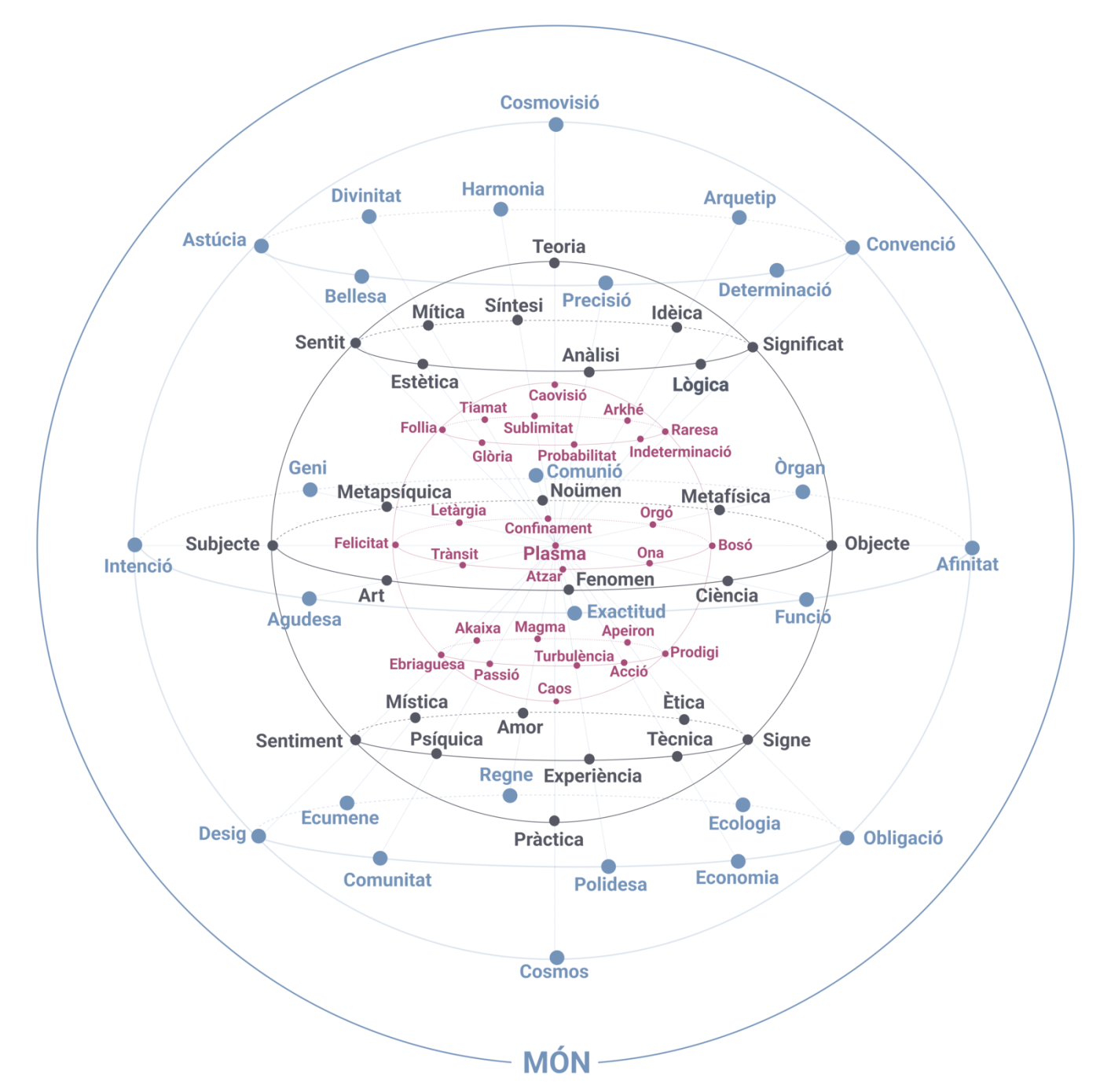
The Globàlium is the lifework of Lluís M. Xirinacs (1932–2007): a knowledge architecture that articulates all the dimensions of reality — theory, practice, subject, object, phenomenon, noumenon, plasma and world — without opposing them or reducing one to another. It is an integrative model, deeply pedagogical, designed to help us think rather than to give closed answers.

We have adopted it at Opengea for three reasons. First, because it combines the rigour of a formal structure with a deeply human gaze. Second, because it offers a shared language across disciplines: economists, engineers, therapists or ecologists can sit at the same table without any one perspective imposing itself as the default frame. And third, because it commits us to a practice that has its own name: globalistics, the discipline of systematically asking which dimensions of a reality we are considering and which we are leaving outside the frame.

We study it and go deeper

Adopting a model is not just printing it on a notebook. You have to inhabit it, put it to the test, let it contradict you. Move from theory to practice. That is why at Opengea we study it continuously: every project and every internal conversation is an occasion to see whether the map helps us understand the territory better — or whether, on the contrary, it needs refining.

This practice has an effect we find decisive: it educates the way of thinking. It places the emphasis on reconciling perspectives rather than confronting them, and reminds us that each angle contributes a part of reality.

Beyond the Globàlium

Xirinacs himself conceived the Globàlium as a provisional and revisable model: a living framework, not a closed system. This constitutive humility allows us — and requires us — to take it further.

If we want this model to be useful in the age we live in, reading it is not enough: our tools must be able to reason with it. This is why we have produced the Meta-Globàlium, a reformulation that preserves its spirit while extending it and making it computable. It is the step that connects a tradition of thought with contemporary technology.

The Meta-Globàlium is what makes tools such as Arkadium possible: a knowledge-organisation model that helps digital systems show which dimensions of a question have been considered and which remain open. It does not replace human judgment — it orients it.

Technology for a new way of thinking

At Opengea we say it plainly: we build technology to drive a new way of thinking and organising ourselves. This motto has two sides. The thinking side means building tools that help us hold complexity without reducing it — arkadium.ai is one example, an experimental artificial-wisdom tool that applies the Meta-Globàlium to map human knowledge in a pedagogical and ethically aligned way. The organising side means building infrastructures of real cooperation: digital ecosystems where people, organisations and territories can meet, commit and measure their social impact — kosmos.coop is one example, a cooperative digital ecosystem at the service of a regenerative economy, connecting people, organisations and territories for the eco-social transition.

Different tools, one shared framework — theory and practice. If technology encodes a worldview, then building it with an integrative model is one of the most direct levers for transforming how decisions are made, how progress is oriented, and how the communities that sustain it are structured.

The technologies we use every day — and, above all, those we are about to integrate at every level — are no longer neutral instruments: they mediate our judgment. That is why we find it revolutionary, particularly in the technological field, to work from a model that does not separate data from meaning, nor performance from responsibility.

It is not a matter of slowing technology down, but of giving it the framework it lacks. Science has given us formidable knowledge; technology turns it into realities that transform us.

«Science is the engine of knowledge; technology is the engine of change.»

Artificial Intelligence is here to stay. The important debate, then, is not whether it is good or bad — that dichotomy is behind us — but how we learn to use it so that it makes us better and makes the world a more habitable place. Against the alarmism that often dominates public conversation, at Opengea we claim a positive outlook: well-conceived technology can make us better, freer and happier. It can broaden attention rather than narrow it, help us cooperate rather than clash, give us time rather than take it away. It does not happen by inertia: it happens when someone decides it must happen, and works for it.

If change is inevitable, then the important question is in which direction. And no algorithm sets that direction: it is set by the models — implicit or explicit — with which we build our tools. Making them explicit, shareable, discussable and regenerated by a community: that is the deep meaning of what we are doing.

The Meta-Globàlium gives us the language. The technology we build at Opengea is its application. And all together, an invitation to think and organise ourselves better.